
15% OFF + Free 24H Trial !
Enjoy ultra-fast, stable IPTV streaming with our premium service.
👉 WhatsApp : +33 7 53 56 27 789
Try it now
Low Latency IPTV Encoder – Complete 2026 Guide for Fast, Real-Time IPTV Streaming
The IPTV industry in 2026 is moving faster than ever. Customers want instant channel switching, zero buffering, real-time sports streaming, and smooth video quality on all devices. To achieve all this, one solution stands out above everything:
👉 The Low Latency IPTV Encoder.
This encoder is designed to reduce the time between the video source and what the viewer sees — making IPTV more responsive, more stable, and more enjoyable.
In this complete guide , you will learn:
✔ What a Low Latency IPTV Encoder is
✔ Why it’s essential for modern IPTV services
✔ How it works
✔ The best settings for ultra-low latency
✔ Top encoder models for 2026
✔ How to choose the right one
✔ How it improves customer satisfaction
✔ How to boost your IPTV service using low latency technology
Let’s begin.
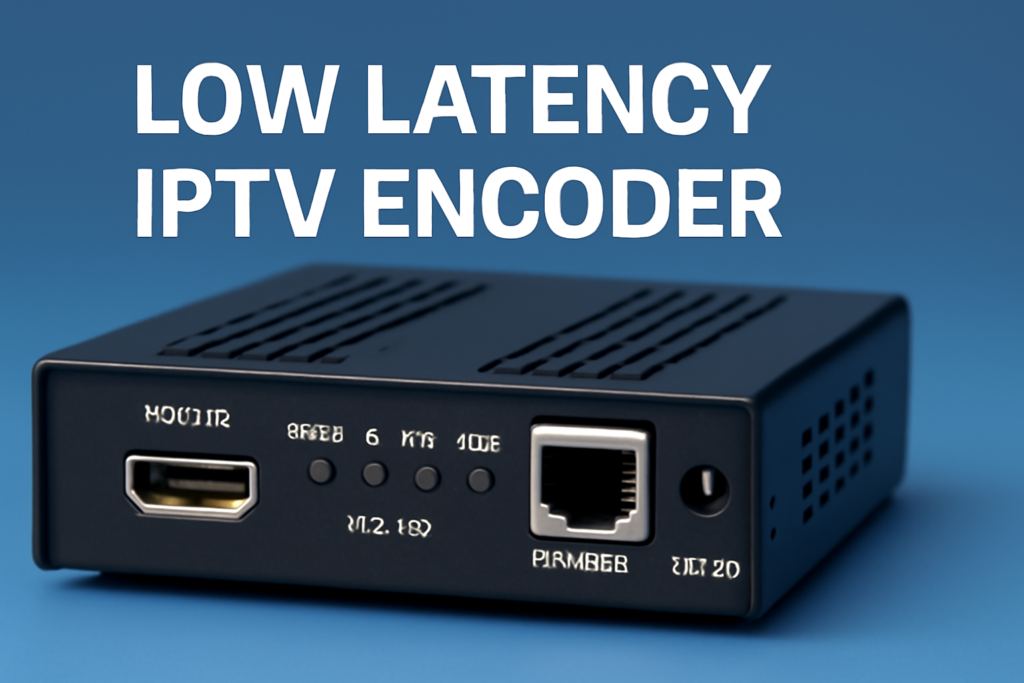
1. What Is a Low Latency IPTV Encoder?
A Low Latency IPTV Encoder is a device or software that compresses and streams video with the lowest delay possible — usually between 0.5 and 2 seconds.
Traditional IPTV encoders have delays of 6–12 seconds, sometimes even 20 seconds depending on buffering.
But today’s customers expect:
- Instant zapping
- Live sports with no delay
- Real-time news channels
- Stable streams even on slow internet
A Low Latency IPTV Encoder solves these problems by reducing the time required for:
- Video capturing
- Compression
- Packet processing
- Transmission
- Playback buffering
It uses advanced protocols (like SRT or UDP) to make streaming extremely fast.
2. Why Low Latency Matters in IPTV
Latency is the difference between:
📺 What is happening in real life
vs
📲 What the viewer sees on the screen
High latency causes:
- Delays in sports events
- Desynchronization
- Slow channel switching
- Annoying “lag feeling”
- Customer frustration
Low latency solves everything.
Benefits of Low Latency:
✔ Real-time sports streaming
Viewers see goals, points, and actions immediately.
✔ Faster channel switching
Switch channels in under 1 second.
✔ Reduced buffering
Buffering is one of the biggest reasons customers cancel IPTV.
A low latency encoder fixes this.
✔ Improved stability
Less delay = less packet congestion.
✔ Better customer satisfaction
Your IPTV service feels premium and more professional.
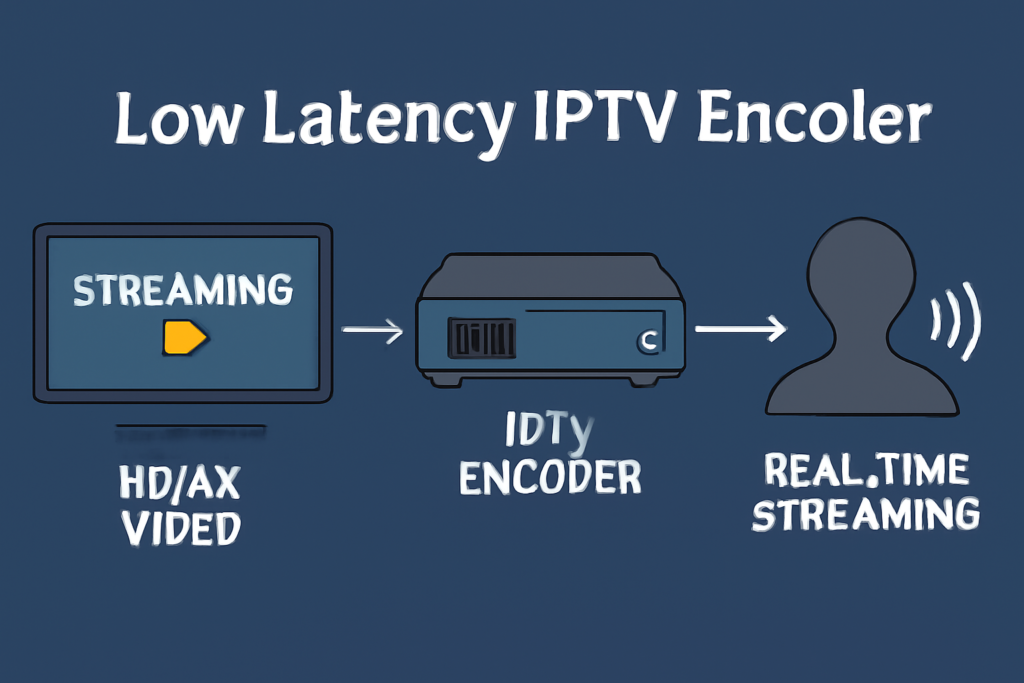
3. How Does a Low Latency IPTV Encoder Work?
Here’s a simple explanation of how this technology functions:
Step 1 – Video Input
The encoder receives video from:
- Satellite receiver
- HDMI device
- SDI source
- Camera
- IPTV set-top box
Step 2 – Fast Compression (H.265 / H.264)
Instead of using heavy compression, the encoder uses optimized settings to keep quality high but processing time ultra-fast.
H.265 (HEVC) is the best codec because it:
- Reduces bandwidth
- Improves quality
- Allows faster transmission
Step 3 – Low Latency Protocol
The encoder sends the stream using:
⭐ SRT (Best option in 2026)
- Secure
- Low latency
- Packet recovery
- Perfect for IPTV
⭐ UDP
- Very fast
- No encryption
- Widely used for IPTV servers
⭐ RTP
- Real-time transport
- Used for professional broadcasting
Step 4 – Stream Delivery
The encoder sends the stream to:
- Xtream UI
- Streaminy
- Stalker Middleware
- TVHeadend
- Your IPTV CDN
- Your private servers
Step 5 – Fast Playback
Your user receives a stream with:
- 1–2 seconds delay
- No buffering
- Smooth transitions
That’s exactly what IPTV customers want.
4. Main Features of a Low Latency IPTV Encoder
When choosing this type of encoder, look for these features:
✔ HEVC (H.265) Encoding
Most efficient codec, reduces bandwidth by 50%.
✔ Low Delay Mode
The encoder must have:
“Low latency mode”, “ULTRA-LOW LATENCY”, “LLH.265”, “fast encoding”.
✔ Protocol Support
Low latency requires:
- SRT
- UDP
- RTP
- NDI (optional)
✔ Multi-Bitrate Output
Allows adaptive streaming (360p, 720p, 1080p, 4K).
✔ Stable 24/7 Operation
The encoder must run non-stop without overheating.
✔ Hardware Acceleration
Dedicated chips > faster encoding > better stability.
✔ 4K Ready
Future-proof option, especially for sports channels.
5. Best Low Latency IPTV Encoders in 2026 (Top 10)
Here is the updated ranking of the best options:
1. Haivision Makito X4 (Best Overall)
✔ Ultra-low latency
✔ Professional broadcasting quality
✔ 4K HEVC
✔ SRT optimized
2. Kiloview E3 (Best Price/Quality)
✔ Dual HDMI + SDI
✔ SRT
✔ Low-delay mode
✔ 1080p / 4K
3. Magewell Ultra Encode AIO (Most Versatile)
✔ Multi-protocol
✔ Low latency
✔ 4K support
✔ IPTV-friendly
4. Epiphan Pearl Nano
✔ Stable 24/7 operation
✔ Very reliable
✔ Great for IPTV servers
5. TBS H.265 PCIe Cards
✔ Multi-channel encoding
✔ Perfect for IPTV farms
✔ Very low latency
6. Hollyland Syscom Encoders
✔ Designed for live events
✔ Very fast
✔ Wireless options
7. Hikvision / Dahua HEVC Encoders
✔ Budget-friendly
✔ Fast encoding
✔ Good stability
8. vMix HEVC Encoder
✔ For production studios
✔ Good low latency performance
9. OBS Studio + NVENC
✔ Software encoder
✔ Good if you have a powerful PC
10. FFmpeg x265 Custom Setup
✔ Free
✔ Flexible
✔ Requires technical knowledge
6. Recommended Settings for Low Latency (Easy Setup)
Use these settings for the best performance:
Video Settings
- Codec: H.265
- Resolution: 1080p
- Bitrate: 3–5 Mbps
- Keyframe: 1–2 seconds
- Latency mode: Low Delay / Ultra Low
Audio Settings
- AAC
- 128 kbps
- 48 kHz
Protocol
⭐ Use SRT for most IPTV services.
⭐ Use UDP / RTP for private server setups.
7. Why Low Latency Encoding Improves IPTV Quality
Here’s what changes when you use low latency processing:
✔ Faster channel switching
✔ Reduced buffering
✔ More stable connections
✔ Better sports streaming
✔ Happier customers (less complaints)
Most IPTV refund requests happen because of buffering and delay.
Fix the encoding → Fix the service quality.
8. Low Latency Encoder for 4K IPTV
4K requires:
- Higher bitrate
- Stronger hardware
- Ultra-fast protocols
A good low-latency 4K encoder uses:
- HEVC
- SRT
- Adaptive bitrate
- GPU acceleration
This makes 4K channels smoother and more professional.
9. How to Choose the Right Low Latency IPTV Encoder
Ask yourself:
1. What resolution do you need?
1080p or 4K?
2. How many channels?
1 encoder or PCIe multi-channel card?
3. Your budget?
$150 → $4000
4. Environment?
Home server or professional studio?
5. Do you need SRT?
Most IPTV providers: YES.
10. Common Mistakes to Avoid
❌ Using only software encoders
❌ Choosing an encoder without SRT
❌ Ignoring hardware cooling
❌ Using high latency settings
❌ Using low-quality bitrate/extreme compression
11. Internal Links to Add (SEO Boost)
Add these to your article:
A Low Latency IPTV Encoder is essential for any serious IPTV service in 2026.
It improves:
✔ Speed
✔ Stability
✔ Streaming performance
✔ Customer satisfaction
✔ Professional image
If you want your IPTV brand to grow and stand out, low latency encoding is the key.